
← All projects Specimen No. 02 · MENA B2B Fintech

From a hiring post to a booked demo, without a human in the loop.

Sorbet, a MENA cross-border payment platform, needed an outbound machine that could find, qualify, sequence, and reply-handle accounts at scale. I designed a 10-step system with three LLM touchpoints, all running off a single Clay table.

ClayClaygentOpenAI GPT-4ApolloTheirStackRB2BInstantlyHeyReachHubSpotSlack
250+ The seed batch demo accounts enriched, scored, and sequenced in Clay
3 LLMs Touchpoints qualification, signal interpretation, and per-row copywriting
$84K Pipeline target ARR projected per monthly 1,000-contact cohort
The soil · the company

Sorbet is a B2B fintech moving cross-border payments on USDC stablecoin rails. ADGM-licensed, serving 3,000+ businesses across UAE, KSA, and Egypt. Pricing is sharp: $0/month, 1% flat per transaction. The value is structural: same-day settlement, MENA-native, no FX margin games.

The seed · the problem

MENA SMBs routing international flows through Wise, Payoneer, or SWIFT absorb 3–5% in FX fees and 3–5 day settlement delays. The market is large, fragmented, and underserved. The objective: design an outbound system that finds these accounts, qualifies them, and reaches the right person — automatically, with an LLM doing the judgment work at every decision point.

The root system · what was built

Ten steps. One Clay table.

A single Clay table drives the whole thing. Every column is either a data source, an enrichment, an LLM decision, or a sync. Each row exits as a sequenced account.

ICP List Building Enrich + Qualify Signal Read Personalize Booked Demo
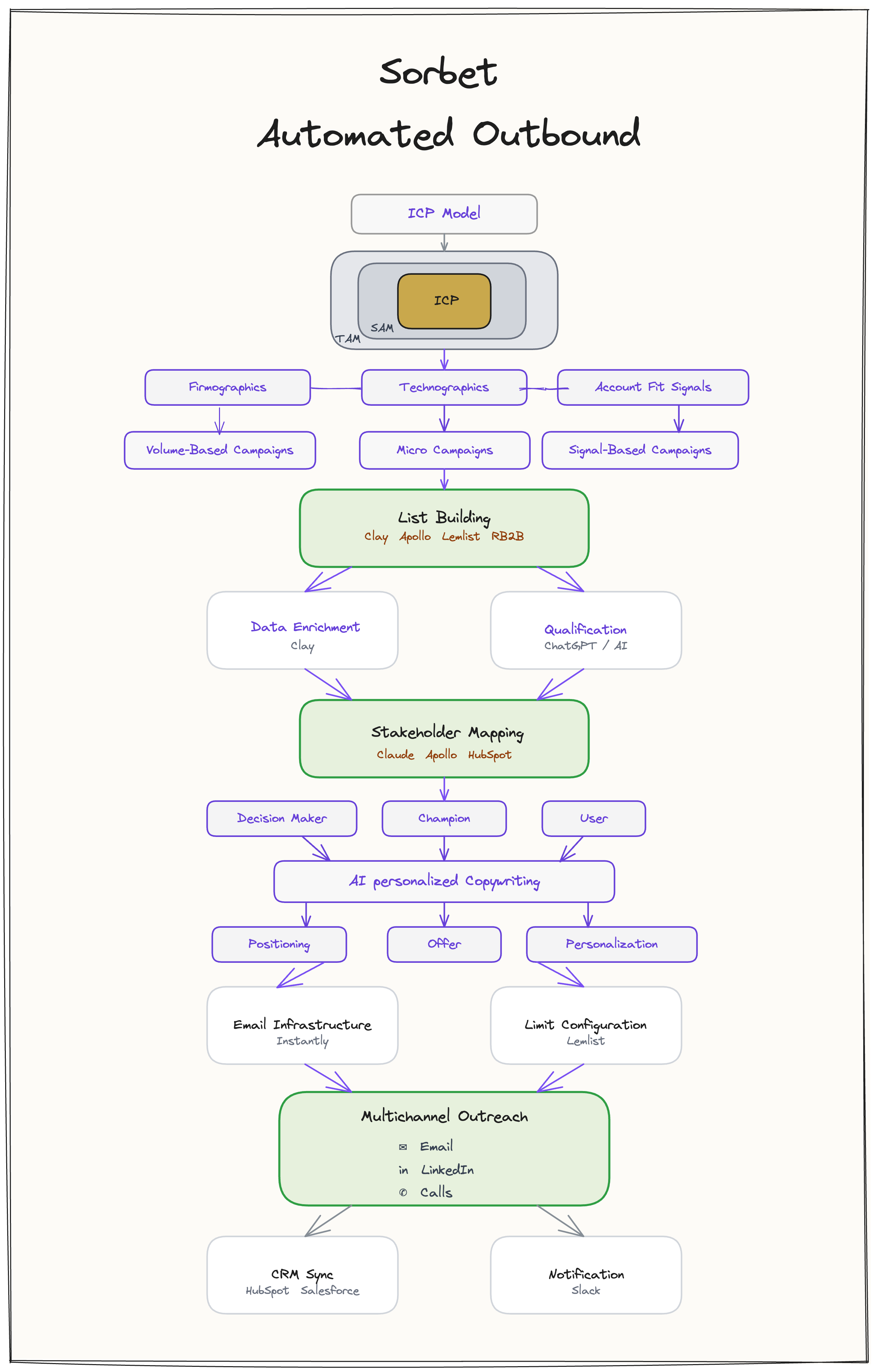
Sorbet automated outbound architecture, sketched in Excalidraw, showing the flow from ICP through list building, enrichment, signal interpretation, AI personalisation, multichannel outreach, and CRM sync.
Excalidraw · the architecture sketch used as the build map
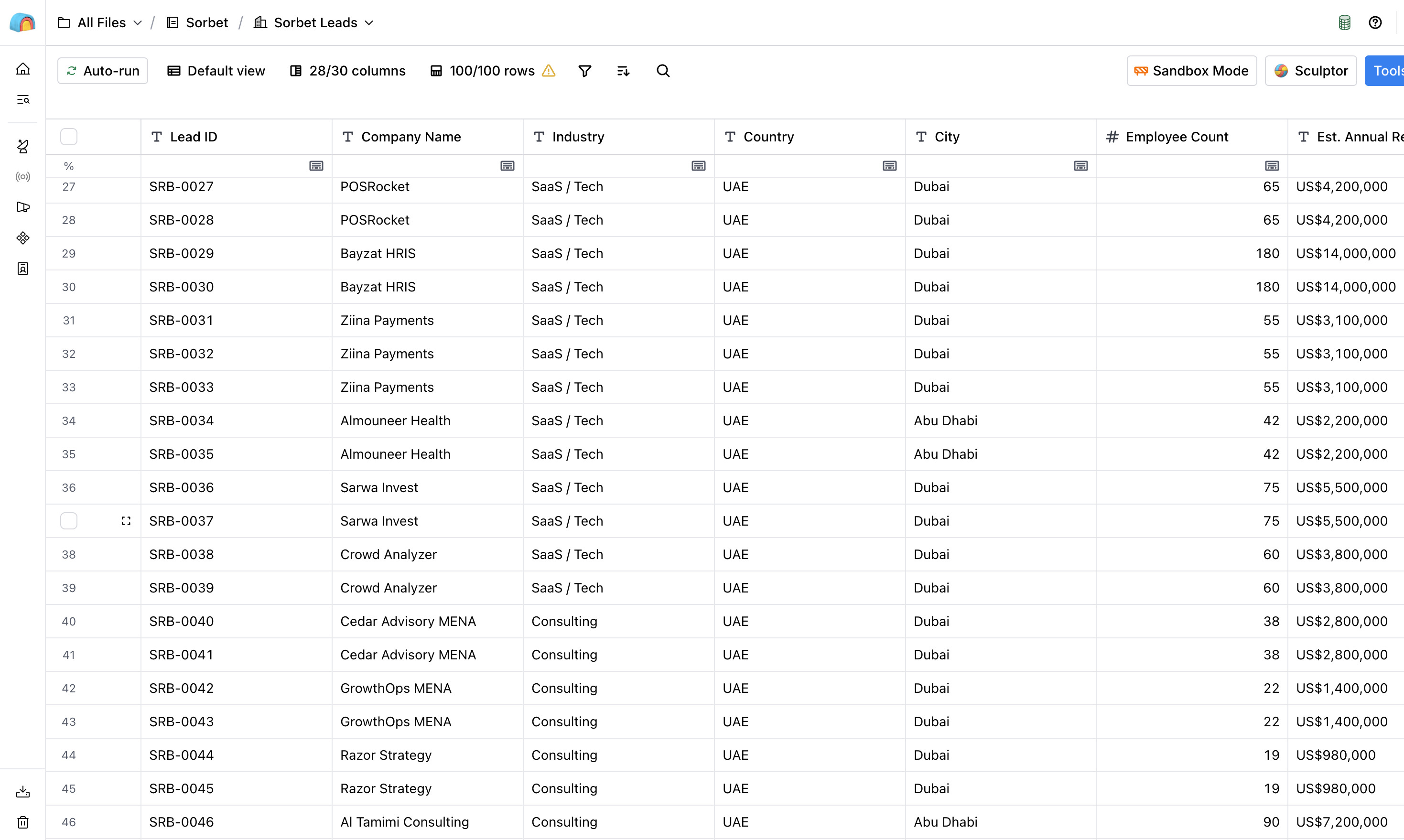
Clay table showing 100 of the 250 Sorbet demo leads with columns for Lead ID, Company Name (redacted for client privacy), Industry, Country, City, Employee Count, and Est. Annual Revenue.
Clay · the demo leads table that drives the workflow (100 of 100 rows shown). Company names blurred for client privacy.
Step 01 · ICP model

Three layers. One tight target.

Campaign type is determined per account by data availability. The ICP layer drives everything downstream: list filters, LLM prompts, copy angle, and channel priority.

TAM · Total Addressable Market
All MENA businesses with any cross-border activity
Startups, SMBs, and enterprise across UAE, KSA, Egypt, Jordan, Lebanon, Morocco engaging in any international financial flow.
SAM · Serviceable Market
MENA SMBs with recurring international payment needs
Remote-first companies hiring globally, e-commerce exporters, and freelancers receiving payments from US/EU clients.
ICP · Ideal Customer Profile
Agencies, SaaS, and consulting firms actively paying with Wise or SWIFT
10–150 employees, $500K–$10M revenue, tech-forward founders, confirmed cross-border vendor or client relationships.
Industry

Digital marketing agencies, SaaS, consulting, e-commerce exporters billing internationally

Company size

10–150 employees · $500K–$10M estimated revenue

Current payment stack

Wise, Payoneer, or SWIFT bank wires — active competitor displacement targets

Geography

UAE, Saudi Arabia, Egypt, Jordan, Lebanon, Morocco

Step 02 · campaign approach

Three plays. Same table.

Campaign type is a column, not a workspace. All three plays share the same enrichment, scoring, and CRM mapping — they diverge only at the copy prompt, where they should.

Play 1 · Volume

Firmographics

Broad top-of-funnel targeting MENA businesses fitting the financial profile: industry, headcount, revenue, and location. Used when no tech signal or intent data is available.

Apollo Sales Nav Ocean.io
Play 2 · Displacement

Technographics

Competitor displacement targeting companies using Wise, Payoneer, Deel, or Stripe in MENA. These accounts have already validated the pain — they just haven't found a MENA-native fix.

TheirStack Fibbler Clay
Play 3 · Intent

Signal-based

Account-fit signals: hiring a Finance Manager, raising a Series A, announcing international expansion. An LLM reads the raw source to extract why Sorbet is relevant right now.

RB2B Jungler Crunchbase
Step 04 · LLM touchpoint 01

Reading the signal. Not just logging it.

A standard workflow labels a signal “hiring” and moves on. Here, an LLM reads the raw source text — the job post, the Crunchbase entry, the news article — and extracts a one-sentence synthesis: exactly why this account should hear from Sorbet today.

LLM Touchpoint 1 of 3 · Signal Interpretation
Raw signal input LLM-generated signal_summary output
LinkedIn post: “We’re hiring a Treasury Analyst in Dubai to manage our international vendor payments.” “Scaling vendor payment volume across borders — actively building treasury function, strong fit for Sorbet.”
Crunchbase: “Raised $4.2M Series A, expanding into EU market.” “Series A with EU expansion signals new cross-border payment flows, likely still on bank wires.”
Job post: “Finance Manager — Riyadh, must have Wise or Payoneer experience.” “Explicitly using Wise/Payoneer — active competitor user, high displacement potential.”

The prompt pattern used in the Clay AI column:

"You are a B2B sales researcher. Read this LinkedIn job post / Crunchbase entry / news article and explain in one sentence why it suggests this company has a growing cross-border payment need relevant to a stablecoin payment platform. Be specific. If there is no meaningful signal, say 'no signal'."

The signal_summary column feeds directly into the AI copywriting prompt in Step 06, so each email opens on a sentence the model has earned the right to write.

Step 05 · stakeholder mapping

Three people. Three conversations.

For each qualified account, Apollo and Sales Navigator surface three contacts by title. Persona type is assigned as a column — it drives a different message angle, offer framing, and CTA downstream.

Decision Maker

CFO · CEO · Finance Director

Controls budget and platform decisions. At companies under 50 employees, this is the founder. Cares about cost savings, compliance, and ROI. CTA: 15-min call to run the numbers.

“Our SWIFT fees are eating 3–5% of every international transfer.”

Champion

Head of Ops · Finance Manager

Will advocate for Sorbet internally. Cares about workflow efficiency, fewer tools, and reliable reconciliation. Reached primarily via LinkedIn. CTA: full product demo.

“I’m reconciling three payment platforms manually every month.”

User

Accounts Payable · Payroll Admin

Executes payments day-to-day. Cares about speed, clarity on fees, and ease of use. At small teams, this is the founder doing it themselves. CTA: free account signup, 5-min setup.

“Transfers take 3–5 days and the fees only show up after.”

Step 06 · LLM touchpoint 02

One column. 250 unique emails.

A GPT-4 column in Clay reads five enriched fields per row — company name, industry, payment tool in use, persona type, and the signal summary — then generates a personalized cold email and LinkedIn DM. No templates. No manual writing.

LLM Touchpoint 2 of 3 · Copy Prompt Pattern
You are a senior B2B copywriter for Sorbet — MENA cross-border payments. 1% per transaction. No monthly fee. Same-day settlement. ADGM-licensed.

Write a cold outreach email for this contact. Use the inputs below.

PERSONA: {persona_type}
— Decision Maker (CFO/CEO): lead with cost savings + ROI. CTA = 15-min call.
— Champion (Head of Ops/Finance Mgr): lead with workflow efficiency. CTA = demo.
— User (AP/Payroll): lead with ease of use and speed. CTA = free account signup.

SIGNAL (why reaching out now): {signal_summary}
PAYMENT TOOL: {payment_tool}
COMPANY: {company_name} · {country} · {industry}

RULES:
- Subject: under 8 words. Specific to signal or persona.
- Body: 3 short paragraphs, under 120 words total.
- P1: Reference signal_summary as the reason for reaching out.
- P2: One sentence on what Sorbet does, framed for this persona.
- P3: Single, low-friction CTA.
- No em-dashes. No exclamation marks. Tone: peer-to-peer.
Step 07–08 · multichannel launch

6 touches. 15 days.

Email, LinkedIn, and calls run simultaneously. Each channel plays to its strength: email for Decision Makers on cost and ROI, LinkedIn for Champions on workflow, calls reserved for accounts showing hard engagement signals.

Day 1
LinkedIn Connection Request

No message. Let it land. Connection acceptance itself signals warm intent before the email hits.

Day 3
Cold Email — Positioning + Offer

AI-personalized per persona and payment tool. Subject line A/B tested across the cohort.

Day 5
LinkedIn DM (if connected)

Brief and curiosity-driven. References company context, not the email thread.

Day 8
Email Follow-up — Pain + Case Study

Proof over pitch. Luna Studio reference. Softer CTA to reduce friction.

Day 12
Call via Nooks

High-intent accounts only: 3+ email opens, link click, or LinkedIn profile view registered.

Day 15
Final Email + LinkedIn Voice Note

Low-pressure close or breakup. Voice note for highest-priority accounts only.

Instantly

Email infrastructure

Sending domains3–5 per campaign
Mailboxes per domain2–3 accounts
Warmup period4 weeks min.
Daily limit / mailbox30–50 emails
Send window8am–5pm recipient TZ
Gap between sends4–8 min randomized
Stop on replyON — critical
HeyReach

LinkedIn limits

  • 15–20 connection requests/day per account
  • 10–15 DMs/day per account
  • Voice notes reserved for warm or high-intent accounts
  • Decision Makers and Champions prioritized over Users
Step 08.5 · LLM touchpoint 03

Every reply routed automatically.

Every reply triggers a webhook. An LLM classifies intent and outputs the next action. No manual triage, no inbox archaeology. A missed positive reply costs the full pipeline value of that account. A per-reply classification costs fractions of a cent.

LLM Touchpoint 3 of 3 · Reply Classification
"Classify this email reply as one of: Positive Interest, Soft Objection, Not Now, Wrong Person, Out of Office, Negative. Then write one sentence describing the ideal next sales action, specific to a cross-border payment platform pitch."
✓ Positive Interest

Prospect is engaged or asks for more information.

Auto-notify SDR via Slack, create deal in HubSpot, trigger pre-call research workflow.

⚡ Soft Objection

Price, timing, or competitor concern raised.

LLM drafts a rebuttal email for SDR review — pre-filled with a counterpoint specific to the objection.

⌛ Not Now

Genuine interest, wrong timing.

Pause sequence. Re-enroll in 30 days with an updated trigger email based on any signal changes.

↗ Wrong Person

Reply redirects to a different contact.

LLM extracts the new name and email from reply text, enriches in Clay, adds to active sequence.

◯ Out of Office

Auto-reply detected.

LLM extracts return date, resumes sequence on that exact date automatically.

✕ Negative / Unsub

Prospect declines or asks to stop.

Immediate suppression across all channels. CRM status updated to Closed Lost.

The harvest · results

A self-feeding pipeline.

Designed to clear 3–8% reply rate and 1–3% positive reply against MENA SMB targets, with 5–15 meetings booked per 1,000 contacts. At a steady 1,000 contacts a month, the system projects $48K–$192K of new ARR pipeline monthly, with the LLM doing the qualification, signal interpretation, and copywriting work that would otherwise require a two-SDR team.

3–8% Reply rate vs. industry baseline of 2–3% for cold outbound
5–15 /1K Meetings booked qualified meetings per 1,000 contacts sequenced
15 days Sequence length 6 touches across email, LinkedIn, and call
Design decisions

Three calls I’d defend in a teardown.

Decision

Three plays, one table.

Volume, Displacement, and Intent run off the same Clay table. Campaign type is a column, not a workspace. Same enrichment, same scoring, same CRM mapping — plays diverge only at the copy column, where they should.

WhyA separate campaign per angle orphans the data. One table compounds it.

Decision

Signal summary in, not signal tag.

A “hiring signal” tag tells you nothing. A one-sentence interpretation tells the copy prompt exactly why this account should hear from Sorbet today, so each email opens with a sentence the model has earned the right to write.

WhyCheaper than a fine-tune, faster than a human researcher, sharper than a tag.

Decision

LLM on reply, not just on send.

Most outbound stacks stop being clever at the inbox. Here, a reply classifier is the third LLM in the system — routing the next action so positive interest never sits unread and objections come with a draft response ready.

WhyA missed positive reply costs the entire pipeline value of that account. A per-reply classification costs fractions of a cent.